


Views: 0 Author: Site Editor Publish Time: 2026-08-04 Origin: Site


Housing high-drive or escape-artist breeds in standard wire crates often causes deep frustration. It can also pose severe physical danger to the animal. Thin wire enclosures simply cannot contain a powerful dog. These lightweight structures bend and snap under pressure. They put your dog at immediate risk of severe self-injury. Building a truly secure enclosure means leaving flimsy plastics behind. You must upgrade to structural-grade metal for reliable, long-lasting safety. This guide provides a transparent, technical breakdown of constructing a secure metal kennel. We evaluate raw metal fabrication against commercial modular solutions. You will learn exactly how to assemble a commercial-grade containment system. This information helps you make a secure, practical decision for your working breed or powerful pet.
Material Matters: True heavy-duty kennels require thick-gauge tubular steel and welded wire; standard "chain link" is insufficient for aggressive chewers.
Fabrication vs. Assembly: Building from scratch requires advanced welding skills, while using a modular heavy duty dog crate system offers commercial-grade security with basic hand tools.
Failure Points: A heavy-duty kennel is only as secure as its weakest joint—usually the hinges, latches, or floor connections.
Safety Compliance: Coatings must be non-toxic and rust-resistant (e.g., powder-coated) to prevent ingestion hazards.
Pet owners usually realize standard crates fail after a dangerous breaking point. You might come home to find bent wires. You might discover broken latches or destroyed property. In severe cases, dogs suffer broken teeth or lacerations while trying to escape. This tipping point signals an urgent need for an upgrade. A standard crate is a temporary management tool. A heavy-duty enclosure serves as a permanent, secure habitat.
You must establish clear success criteria to classify an enclosure as truly heavy-duty. A secure build must address three critical functional areas:
Structural Integrity: The frame must withstand continuous bodily impact. It cannot suffer frame deformation or joint failure.
Chew Resistance: The spacing and thickness of the infill material must prevent teeth from gaining any leverage. Thin wires allow dogs to hook their jaws and pull.
Escape Prevention: The enclosure needs dual-latch systems. It also requires enclosed tops to prevent latch manipulation and climbing.
Standard wire crates work perfectly fine for roughly 80% of domestic dogs. However, working breeds like Belgian Malinois and German Shepherds demand more. Dogs suffering from severe separation anxiety also generate incredible force. These specific profiles require commercial-grade containment. They treat thin wire as a mere puzzle to solve or chew through. Recognizing this reality is the first step toward building a safe environment.
Selecting the right raw materials forms the foundation of structural integrity. You cannot compromise on frame thickness. We highly recommend using 14-gauge to 16-gauge steel tubing for the primary skeleton. The lower the gauge number, the thicker the steel wall. Aluminum offers excellent rust-proof qualities. However, aluminum lacks the tensile strength required to contain high-impact dogs. A panicked working dog can bend aluminum tubing. Steel absorbs these impacts effectively.
You must also carefully select the mesh or infill panels. Heavy-duty welded wire mesh provides excellent visibility and strength. Expanded metal offers even greater chew resistance because it contains no welded joints to snap. Expanded metal sheets are cut and stretched from a single solid piece of steel. This makes them virtually indestructible against canine teeth. Historically, owners relied on a traditional iron dog cage for maximum security. Early iron designs were incredibly strong but prone to rapid rusting. Modern iterations solve this problem. Today, manufacturers use high-carbon steel treated with advanced coatings to deliver superior durability and rust prevention.
You must strictly evaluate toxicity and coating risks. Dogs explore the world using their mouths. A determined chewer will inevitably scrape their teeth against the enclosure bars. You must avoid using hot-dipped galvanized metals in chew zones. Excessive zinc ingestion can cause toxicosis. Cheap spray paints will flake off and create ingestion hazards. You should emphasize using food-grade or non-toxic powder coating. Powder coating bakes a dry powder into a solid, durable shell over the metal. It resists chipping and keeps your dog safe from chemical exposure.
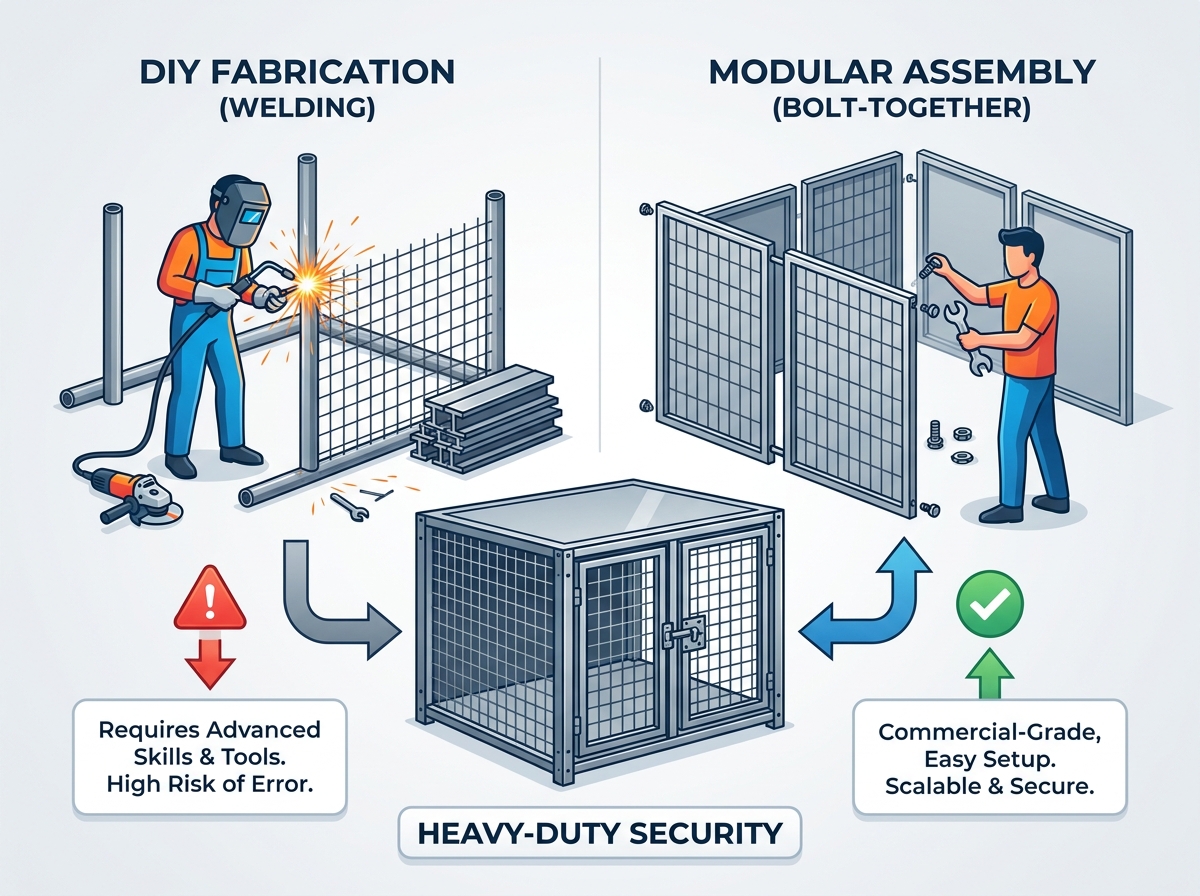
You face two distinct building paths when securing a powerful dog. You can fabricate the structure from scratch, or you can assemble pre-engineered components. We evaluate these paths based on time investment, safety guarantees, and labor intensity.
Path A involves true DIY fabrication. You build everything from scratch. This route requires specialized equipment. You need a MIG or TIG welder. You also need angle grinders, metal chop saws, and reliable raw steel sourcing. This path carries a very high margin for error. A novice welder often creates "cold welds." These joints look solid but lack internal penetration. Cold welds easily snap under sudden canine impact. Snapped steel creates razor-sharp hazards. DIY fabrication demands advanced metalworking skills to guarantee safety.
Path B relies on the modular approach. This method involves bolting together pre-fabricated, commercial-grade panels. You connect these sections to create a highly secure modular heavy duty dog crate or an expansive outdoor run. This system uses basic hand tools. You do not need welding experience.
Modular systems offer incredible scalability. You can easily expand the footprint. You can add roof panels later. You can reconfigure the layout if you move houses. You accomplish all of this without cutting or grinding metal.
Building from raw steel might seem straightforward, but it requires massive labor and specialized tooling. The structural guarantees provided by factory-welded modular systems make assembly the smarter choice. You eliminate the risk of joint failure. You protect your dog efficiently.
Evaluation Dimension | Path A: DIY Welding | Path B: Modular Assembly |
|---|---|---|
Tool Requirements | MIG/TIG Welder, Grinders, Saws | Wrenches, Screwdrivers, Mallet |
Labor Intensity | Extremely High (Days to Weeks) | Low (Hours) |
Safety Margin | High risk of cold welds snapping | Factory-tested joint strength |
Scalability | Requires cutting and re-welding | Simply bolt on additional panels |
The assembly process dictates the final strength of the enclosure. You must ensure maximum security during installation. This guide focuses on assembling a commercial-grade modular panel system.
Site Preparation and Flooring: You must start with a perfectly level foundation. For outdoor runs, level the dirt and consider laying a concrete pad. Concrete prevents digging and provides a sanitary surface. If assembling indoors, protect your interior floors. Use high-density rubber stall mats. You must anchor the frame directly into the floor. Powerful dogs can shift unanchored enclosures across a room. Use concrete wedge anchors outdoors. Use heavy-duty floor brackets indoors.
Squaring the Frame: An out-of-square frame weakens the entire structure. Connect the heavy-duty panels loosely at first. You must use commercial heavy-duty clamps or solid bolt-through designs. Check the corners using a carpenter's square. Once squared, tighten every bolt systematically. You must ensure there is absolutely no "give" or rattling when you shake the panels. Rattling indicates loose joints. Loose joints degrade over time.
Securing the Weak Points: The door gate represents the most vulnerable section. Install the gate panel carefully. Test the swing clearance. Emphasize the alignment of your latches. Drop-pin latches or slam latches provide excellent security. You must ensure the latch engages fully without friction. A misaligned latch can vibrate open. Install secondary carabiners or padlocks for dogs known to manipulate handles.
Roof and Base Bracing: High-drive dogs often attempt to climb out. You must add top roof panels. Secure these roof sections using the same bolt-through clamps. Roofs prevent climbing escapes entirely. Finally, install base brackets. Base bracing prevents the dog from pushing the bottom walls outward. A determined dog will use its back and legs to pry the bottom track up. Base braces anchor the panels firmly to your flooring.
Following these specific steps guarantees structural integrity. A properly assembled heavy duty steel dog kennel will safely contain even the most determined escape artist.
Modular panel systems cover most containment needs. However, certain unique scenarios demand a tailored approach. You might face highly uneven terrain outdoors. You might need to integrate the enclosure directly into an existing outbuilding or garage corner. Multi-dog boarding setups often require specific space configurations. Standard panels might not fit these distinct dimensions.
These specialized scenarios require professional fabrication. If you commission a custom dog kennel, you must ask the fabricator critical technical questions. Do not assume all welders understand canine containment.
Ask about weld penetration: Ensure they use full-seam welds on every joint, rather than quick tack welds.
Ask about anti-corrosion applications: Verify they offer professional powder coating, not just standard spray paint.
Discuss custom gap sizing: Specify the exact gap width between bars. The gap must be too narrow for your specific dog to wedge its jaw into.
You can use a quick checklist to decide your next move. Measure your available space. Note any slope or wall obstructions. Assess your dog's size, bite force, and previous escape history. If you have a flat surface and standard dimensions, choose a premium modular kit. It saves time and guarantees safety. If you have irregular space or unique architectural requirements, contact a specialized fabricator.
Building a high-security enclosure relies entirely on eliminating structural weak points. You must prioritize material quality over aesthetics. Ensure you use thick metal gauges, strong weld joints, and tamper-proof latching mechanisms. Unless you possess extensive welding experience, investing in pre-engineered steel panels remains the safest route. Modular kits deliver factory-tested reliability. They remove the guesswork from canine containment. Evaluate your dog's physical strength and behavioral needs today. Compare those needs against available commercial panel specifications to select your ideal setup. Take action to build an enclosure that keeps your powerful dog secure.
A: A heavy-duty frame requires 14-gauge or 16-gauge steel tubing. The lower the gauge number, the thicker the metal. Avoid 8-gauge wire for the main frame. Wire lacks the rigidity to withstand high impacts. Thick steel tubing provides the necessary structural backbone.
A: Yes, if the latches fail or the joints have weak "cold welds." Dogs usually target the door. You must use dual-locking mechanisms like drop-pin or slam latches. Avoid standard barrel bolts. Smart dogs can manipulate barrel bolts using their paws or tongue.
A: You must select materials finished with a professional powder coating. Powder coating bakes a protective shell onto the steel. It outperforms standard spray paint significantly. Regularly inspect panel joints and hardware. Apply touch-up paint immediately if you notice deep scratches.
A: Buying raw steel seems cheaper initially. However, when you factor in purchasing a welder, cutting tools, hardware, and safety gear, building from scratch requires significant upfront capital. Buying a pre-made modular kit is far more practical for most pet owners.


